Portfolio case study
One governed ARR metric, shown as a demo.
This page is a visual walkthrough of how one executive metric can be defined once, validated properly, and reused through a governed consumption layer without every consumer rebuilding it differently.
Why this was built
ARR is a useful test case because the number only works when the definition is precise enough to survive real operational edge cases and reconciliation across systems. This case study shows how one certified metric becomes a shared contract for the business.
The goal is to make one ARR answer that business leaders, data teams, BI tools, and agents can trust.
ARR definition
ARR is the annualized recurring revenue run rate at month end. In this case study, Ending ARR is the certified number, and net ARR movement explains the monthly change in that number.
One time fees and non recurring revenue are excluded so the metric stays tied to recurring value.
The data org should work closely with business leaders to define the metrics, because they have the clearest view of what can be captured today and what is realistically possible to capture next.
The framework at a glance
The system is intentionally layered so each part has one job and one owner.
1. Define
Set ownership, boundaries, inclusions, and exclusions in plain language.
2. Structure
Build staging, templates, and intermediate layers so upstream and downstream logic stay modular and easy to review.
3. Validate
Use fixtures, tests, and contracts to prove the model behaves as expected.
4. Publish
Expose the certified metric through Snowflake and the semantic layer for reuse.
How the project is structured
The model slice
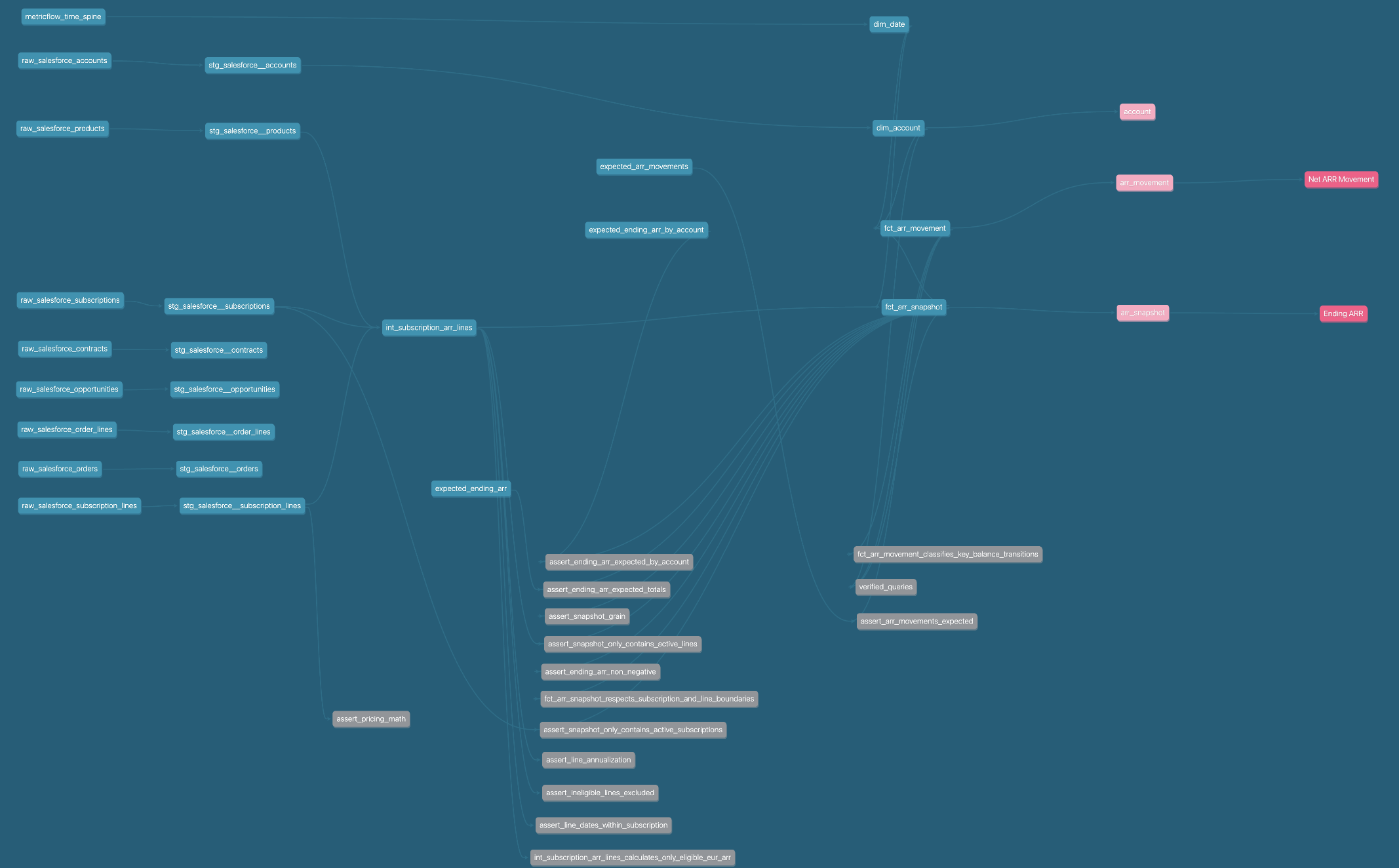
The project centers on one intermediate model that owns ARR eligibility and annualization. That layer is where the business definition becomes code.
If that logic were buried in the final output, the metric would still run, but it would be much harder to review, explain, or defend.
What the lineage proves
- Source cleanup is separated from business logic.
- The metric logic is isolated and reviewable.
- The certified facts are not mixed with draft logic.
- Consumption happens through a governed surface, not ad hoc copies.
How validation works
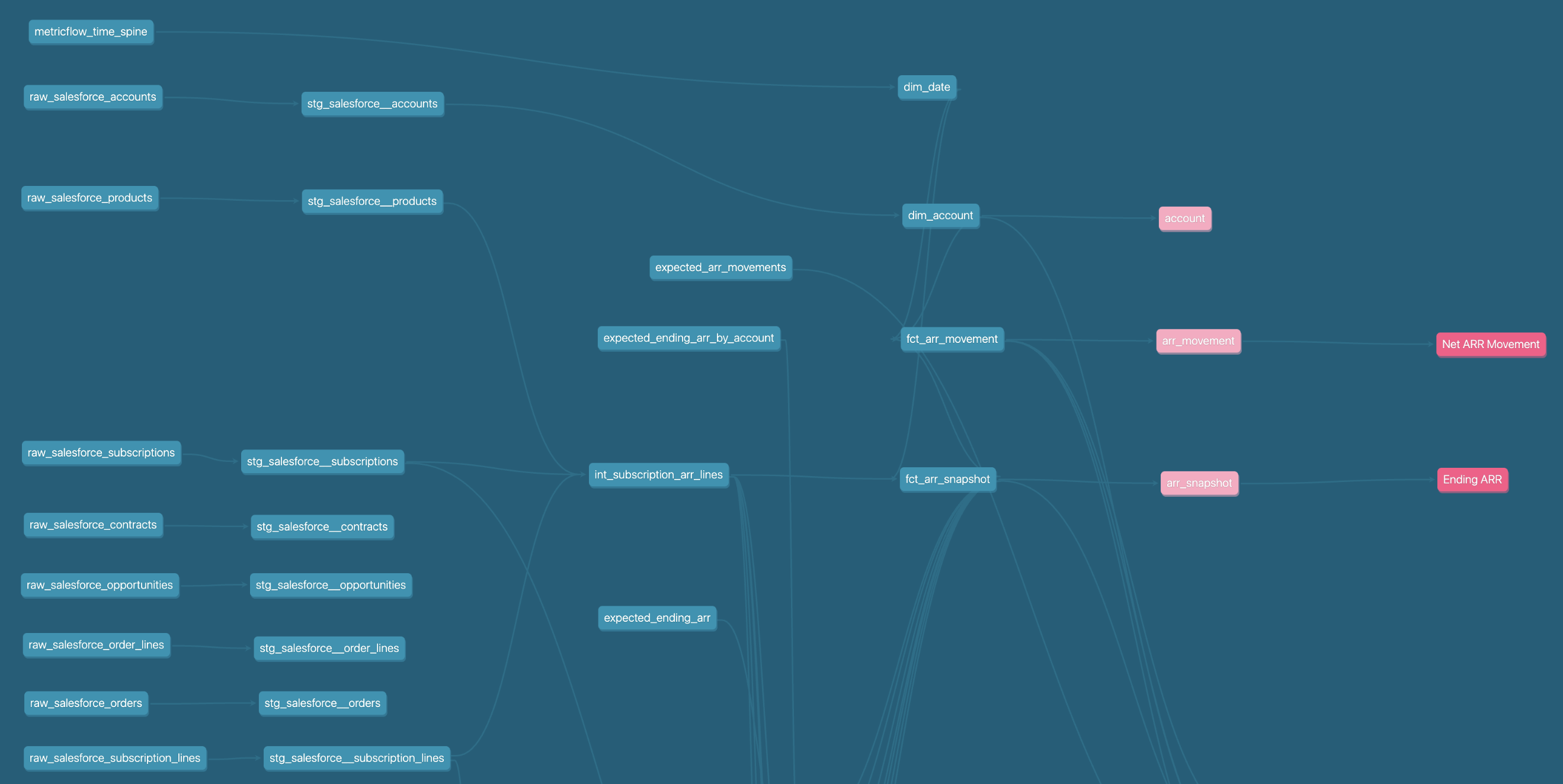
This is the part that makes the framework credible. Validation is not abstract here. It is visible in the repo as separate artifacts that each catch a different failure mode.
Each snippet below is a trimmed excerpt from the project, chosen to show how the framework protects the metric at different layers.
Data tests
Purpose: catch broken inputs and invalid published values before the metric is consumed.
models:
- name: fct_arr_snapshot
columns:
- name: ending_arr
tests:
- not_null
- dbt_utils.expression_is_true:
expression: "ending_arr >= 0"
Unit tests
Purpose: prove the business logic behaves correctly for a narrow scenario, not just in aggregate.
select account_id, reporting_month, line_arr
from {{ ref('int_arr_monthly') }}
where billing_interval_months <= 0
or line_arr < 0
Fixtures
Purpose: provide manually checked reference outputs so the team knows what right looks like.
account_id,reporting_month,expected_ending_arr
A-102,2025-03-31,30600.00
A-102,2025-04-30,30240.00
A-204,2025-06-30,25320.00
Contracts and assertions
Purpose: enforce the published shape and guard the certified layer against silent drift.
config:
contract:
enforced: true
select *
from {{ ref('fct_arr_snapshot') }}
where ending_arr < 0
Validation stack in practice
Why this matters
Without validation, the line between “it runs” and “it is correct” stays blurry. This framework makes that line visible.
What the reviewer should notice
The output is not being trusted on faith. It is being checked against expected answers, business rules, and explicit contracts before it is consumed.
Snowflake Semantic Layer Implementation
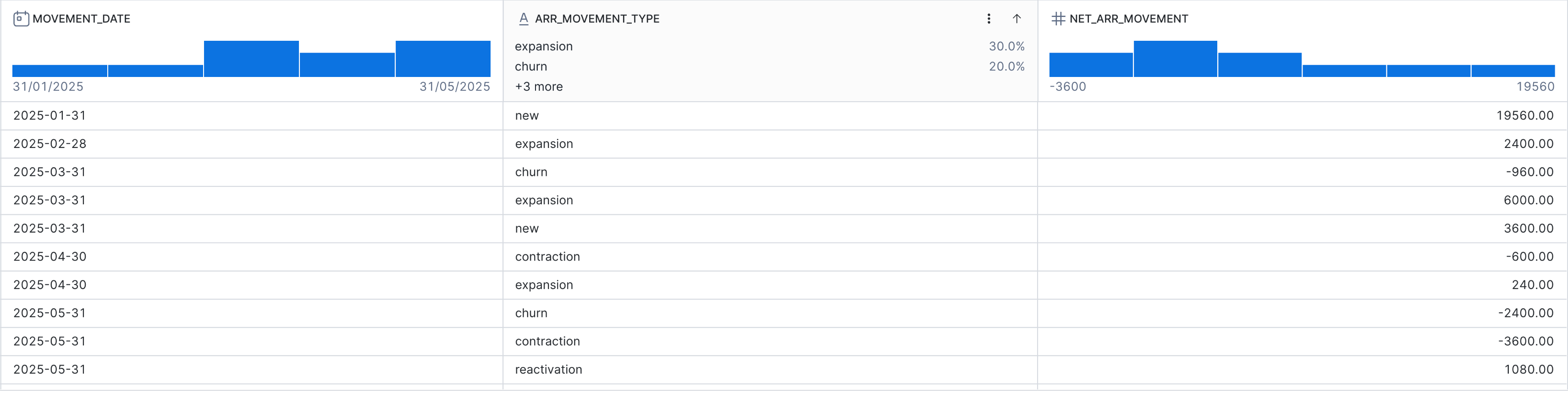
The Snowflake layer is implemented as a SQL based semantic view in snowflake_semantic_views/snowflake_revenue_metrics.sql. The object is validated with Snowflake metadata checks, and its behavior is proven with semantic_view() queries that return certified ending_arr and net_arr_movement outputs. The screenshots below show the definition, the exposed concepts, and the resulting governed answers. Data and BI tools or agents can consume the same governed surface to generate curated insights about the business.




What was intentionally left out
This is a focused lab, not a complete revenue platform.
Excluded on purpose
- Live dashboard deployment
- Multi currency
- Usage based pricing
Also excluded
- Row level security
- Historical type 2 account dimensions
- Broad KPI catalogues
Those are valid next steps. They would also distract from the thing this piece is trying to show: how a single metric becomes trustworthy enough to reuse.
Why this matters beyond ARR
The broader lesson is not just that metrics should be trustworthy. It is that a governed metric can become shared infrastructure.
Once a number is defined once, tested automatically, and published through a controlled surface, it stops being a local reporting artifact and starts becoming a building block. Finance can reconcile against it. Analysts can reuse it without rewriting the logic. Product and operations can trigger workflows from it. AI can consume it without inventing a private version of the truth.
That is the real payoff: not a prettier dashboard, but a metric the business can build on without re litigating the definition every time it appears.