Trusted Metrics Need More Than Definitions
Most metric problems do not start as technical problems. They start as trust problems. This piece builds on the governed ARR case study and turns one certified metric into a repeatable model for operating metrics with confidence.
Trusted Metrics Need More Than Definitions
Two teams use the same metric name but get different answers. A dashboard looks right until someone asks what is excluded. A business rule changes, but no one is sure which reports need to be updated. An AI assistant can query the data, but it has no reliable way to know which version of the metric is approved.
That is the real metric problem. It is not only whether a team can calculate the number. It is whether the organization can trust the number, change it deliberately, and reuse it without rebuilding the same logic in every dashboard, spreadsheet, and AI prompt.
The first ARR case study answered a narrow implementation question: can one business-critical metric, Ending ARR, be defined clearly, modeled in dbt, tested end to end, and exposed through a governed semantic layer?
The example is based on a working governed ARR project built with dbt, fixture-backed validation, and Snowflake semantic-view deployment checks.
Can that same metric be operated as a controlled, reusable metric product?
This article uses ARR as a concrete example of the operating model required to make a metric trusted, changeable, and reusable across reporting, business reviews, and AI consumption.
From Implementation to Operating Model
The ARR implementation proves that the metric can be built. The operating model proves that it can be owned, validated, published, deployed, changed, and revalidated without losing trust in the answer.
That distinction matters. A metric definition describes meaning. A model calculates it. A semantic layer gives that result a governed consumption surface: approved dimensions, entities, measures, labels, non-additive time behavior, synonyms, verified queries, and AI-facing instructions where the platform supports them. But even a strong semantic layer does not, by itself, decide who can change the metric, how changes are approved, what evidence proves the result, or how downstream consumers know they are using the certified version.
| Question | Implementation answer | Operating model answer |
|---|---|---|
| Can we calculate it? | dbt models produce the tested Ending ARR output used for certification. | The calculation is tied to an approved definition and expected results. |
| Can we trust it? | Tests and fixtures validate the model. | Business owners can review scenarios, approvals, and release evidence. |
| Can others reuse it? | The metric is exposed downstream. | BI, reporting, and AI consume the same governed semantic surface. |
| Can we change it later? | The SQL can be updated. | A controlled process captures the decision, effective date, impact, and revalidation after the original metric is certified. |
ARR is the example. The reusable asset is the operating discipline around it.
Why Start With One Metric
When organizations try to govern metrics, the instinct is often to start with a catalog. List every KPI, assign owners, and document definitions across the business.
That work has value, but it can become abstract quickly. A catalog can say what a metric means without proving that the metric can be operated.
What has to exist around this metric before the business, dashboards, and AI systems can rely on it?
ARR is a useful stress test because it looks simple from the outside but is not simple in practice. A credible ARR metric has to handle effective dates, subscription status, billing intervals, discounts, renewals, churn, reactivation, product eligibility, and the difference between a month-end balance and a value that can be summed across time.
ARR definitions also vary by company and source system. Contract ARR, billing-derived ARR, and finance-recognized revenue are not the same thing. The operating model does not declare a universal ARR truth; it governs the chosen definition so the business knows exactly which answer is approved.
If the process can handle ARR, it provides a strong starting pattern for other governed metrics, though each metric still needs its own grain, owner, controls, temporal logic, and consumption rules.
The specific metric can change. The operating pattern should remain repeatable: well defined, tested, trusted, and reusable across the business.
The business outcome is not only a cleaner ARR number. It is fewer reconciliation cycles, faster agreement on metric changes, clearer executive confidence, and a reusable path for the next business-critical metric.
The Operating Model
A governed metric needs a lifecycle, not just a model or definition page. The lifecycle is simple: define the metric, specify the operating rules, build the governed assets, validate the result, certify the approved answer, publish it for consumption, operate it, and send any change back through impact review and revalidation before release.
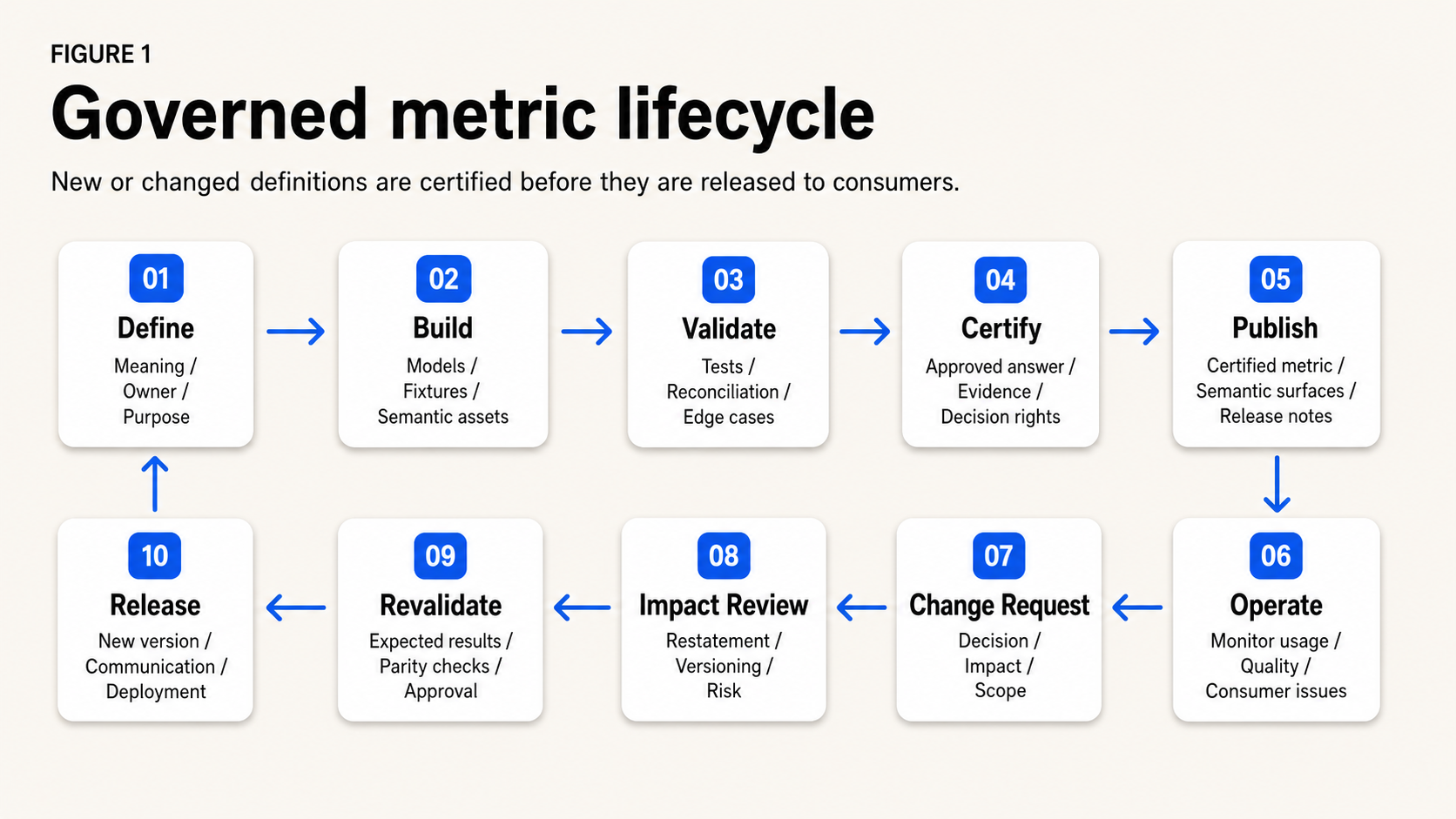
The important point is the loop. A production metric is not finished when the first version ships; it needs continuous operating visibility and a controlled path for review, revalidation, release, and retirement whenever the approved definition changes. In the ARR project, that visibility starts with DQ models that monitor whether the staging inputs remain complete, valid, fresh, properly related, and free of obvious duplication or coverage issues. Those checks validate known quality rules. A future maturity step would snapshot certified outputs and selected metric drivers on a defined cadence, so material movements can be explained before they harden into executive reporting or commercial disputes.
Ownership Comes First
A metric operating model is cross-functional by design, but it does not require a large committee. It requires explicit ownership.
The business owner is responsible for meaning. For ARR, that might be Finance, Revenue Operations, or another commercial owner. This person or team decides what the metric represents, which exclusions are valid, which changes are material, and whether a definition change should restate history or apply only going forward.
The data team is responsible for implementation and technical validation. They translate the approved definition into models, tests, fixtures, semantic definitions, deployment checks, and operating views.
Downstream teams are responsible for usage. They need to know what the metric can answer, which dimensions are approved, and which interpretations are invalid.
A metric without an owner eventually becomes a query with a nice name.
Start With a Metric Specification
The best place to start is not the semantic layer. It is the metric specification.
The metric specification is where business meaning becomes implementable. Before writing transformation logic, the business and data teams should agree on the definition, certified grain, valid dimensions, exclusions, invalid uses, source inputs, expected outputs for known scenarios, ownership, and approval path.
This is different from a dbt model contract. A dbt contract protects a model interface from silent schema drift by enforcing expected columns and data types. A metric specification defines the business meaning, operating rules, validation evidence, and approved consumption behavior for the metric itself.
Change rules still belong in the specification, but they should not dominate the first build. First the team needs to prove the original metric: definition, implementation, validation evidence, certified output, and governed publication.
Validation, Publication, and Deployment
Testing is necessary, but the goal is not simply to have many tests. The goal is to prove the behavior that matters.
For a metric like ARR, the team should be able to point to a small controlled scenario and say: given these inputs and this policy, this is the approved monthly result. That creates a shared language between business and data teams. The business does not need to review every SQL expression. They can review the scenario, the policy, and the expected result.
The same principle applies to data quality. Finance and RevOps stakeholders should not need to inspect staging models, joins, or raw table-level checks. Their role is to define the metric and validate that the implemented output behaves as expected.
The data team owns the technical validation, but that validation is broader than basic data-quality checks. Required fields must be populated, status values must be valid, relationships and grain must hold, the reporting window must be covered, temporal rules must behave correctly, edge cases must be represented in fixtures, expected-answer tests must reconcile to approved results, and semantic-layer outputs must match the governed model.
Once the metric is certified, it needs to be published through governed interfaces. In this implementation, that means both the dbt Semantic Layer and a Snowflake native Semantic View. Those tools are specific to the project, but the principle is broader: semantic layers should expose the governed metric, not recreate it.
The governed metric specification remains the source of truth. dbt models, dbt contracts, and semantic-layer objects are deployed representations and controls that must reconcile to the same approved result.
Deployment is also a validation step, not just a release step. The release is not complete when SQL compiles or an object exists. It is complete when the deployed semantic interface can be inspected, queried, and reconciled back to the expected ARR results used during validation.
Where AI Fits
AI makes the semantic layer more important, not less.
If an AI assistant queries raw subscription tables, it can easily invent its own version of ARR. It may count paused subscriptions, sum ARR across time, confuse ARR with recognized revenue, or ignore the certified grain.
That is exactly the problem governed metrics are meant to prevent.
AI should consume the approved semantic layer, not raw implementation tables.
The tool can vary. The principle should not: AI should query the approved metric surface.
This still requires access controls, query audit logs, approved dimensions, and evaluation of AI-generated answers against known scenarios. The semantic layer reduces ambiguity; it does not remove the need for governance around the assistant.
In the reference project, this is demonstrated through semantic metadata, verified queries, and Snowflake semantic-view guidance rather than a fully deployed AI assistant.
In that sense, the semantic layer is not just a convenience for BI. It is a safety layer for AI consumption.
Only Then: Change Tests the Operating Model
Once the original metric is defined, tested, certified, published, and deployed, change becomes the real test of the operating model.
Business definitions change. A team may decide that paused subscriptions should no longer count toward ARR, that a customer must be engaged for a different number of days to be considered active, or that a product family should be excluded from a retention metric. At that point, the question is not whether someone can edit SQL. The question is whether the team can change the approved metric without breaking trust in prior reporting or downstream consumption.
Paused subscriptions are excluded from certified Ending ARR from 2025-04-01 onward.
The rule is intentionally small. That is why it is useful. A small definition change exposes whether the team has an actual operating process or just an informal understanding.
| Change element | ARR example |
|---|---|
| Business decision | Exclude paused subscriptions from certified Ending ARR. |
| Effective date | Apply the rule from 2025-04-01 onward. |
| Restatement policy | Prospective change unless Finance approves a historical restatement. |
| Affected assets | ARR eligibility logic, certified monthly facts, semantic definitions, validation fixtures. |
| Validation evidence | Expected monthly totals and a dbt assertion against the approved result. |
| Release evidence | Deployed semantic query reconciles to the same certified ARR result. |
Without those controls, the definition changes in conversation but not reliably in production. With them, the change becomes auditable: the business decision is recorded, the technical impact is known, prior certified periods are protected unless restatement is approved, and the final semantic output can be reconciled back to the approved result.
The Main Lesson
The work started with one question: can one ARR metric be modeled clearly and tested end to end?
The next question is more useful: can that metric be operated like a real business asset?
The answer depends on what exists around the metric: ownership, a metric specification, tested implementation, visible data quality, governed semantic publication, deployment validation, and a controlled path for change.
At that point, ARR is no longer just a number in a dashboard. It is a controlled business asset that dashboards, Finance reviews, RevOps workflows, and AI systems can use with confidence.
The governed metric operating model is the product.