The Operating Blueprint for Trusted Metrics
Most metric governance efforts stop at definitions. This blueprint starts with operations: the ownership, contracts, validation evidence, semantic surfaces, deployment checks, and change controls a metric needs before the business can trust it. It is grounded in a governed ARR semantic-layer project, so it separates what was actually implemented from what a production rollout would still require.
How to Use This Blueprint
Definitions are necessary, but they are not enough. A decision-ready metric also needs ownership, a contract, validation evidence, data-quality controls, approved publication paths, access rules, release mechanics, and a way to manage change without breaking trust.
This blueprint is written for analytics engineering, data architecture, and data leadership teams that need to move a critical metric from agreed definition to certified production consumption.
Use it as an implementation checklist grounded in one scoped project: governed Ending ARR built with dbt, DuckDB for local validation, and a Snowflake native semantic-view deployment path. The pattern can generalize, but this article does not claim controls the reference repo does not implement.
The business value is not cleaner documentation. It is fewer reconciliation cycles, fewer dashboard forks, safer metric changes, faster executive agreement, and a repeatable path for exposing trusted metrics to BI and AI consumers.
The goal is not to govern every metric at once. It is to prove, with one business-critical metric, that the team knows how to define, validate, publish, change, and inspect a metric as an operated asset.
What the ARR Lab Actually Implements
The reference project is intentionally scoped, but it is not only a SQL demo. It contains the artifacts needed to review one metric product from raw Salesforce-style fixture inputs through governed marts, semantic publication, quality checks, and a documented definition change.
| Implemented component | Evidence in the ARR repo |
|---|---|
| Metric contract | docs/metric_contract_arr.md defines owner, status, cadence, currency, certified grain, approved dimensions, invalid uses, controls, change process, and change log. |
| Expected answers | Seed fixtures define expected Ending ARR totals, account-level totals, ARR movements, and the paused-subscription policy-change impact. |
| dbt validation | Singular tests, unit tests, and enforced model contracts protect annualization, eligibility, active dates, pricing math, grain, movement classification, and expected totals. |
| Quality observability | ARR DQ models expose completeness, validity, duplicate-risk, freshness/coverage, referential-integrity, and summary views for staging inputs. |
| Governance gate | scripts/governance_check.py checks that required metric-product controls exist and fails when critical artifacts are missing. |
| Semantic publication | models/semantic/sem_arr.yml defines the dbt semantic surface, and models/snowflake_semantic/revenue_metrics.sql defines the Snowflake native semantic view. |
| Deployment checks | CI parses multiple targets, runs focused unit tests, builds modified nodes and the full local project, validates the semantic contract, and runs the governance gate. |
What This Lab Does Not Yet Prove
The repo is a governed-metric lab, not a full enterprise deployment. That boundary makes the example more useful, because it is clear what is implemented and what would still need to be added before broad production adoption.
- Live production ingestion and producer-side source contracts
- Finance-close or recognized ARR reconciliation
- Production orchestration and recovery procedures
- Row-level security, masking, and entitlement inheritance
- Multi-currency and usage-based pricing logic
- Hosted dbt Semantic Layer query proof
- Historical type-2 account dimensions
- Broad AI evaluation, audit logging, and fallback behavior
Those gaps do not weaken the blueprint; they define the next layer of work. The article treats them as production extensions, not as claims already proven by the lab.
Implementation Sequence
A governed metric should move through a sequence that is explicit enough to audit and light enough to repeat. The sequence is not a waterfall; when a rule changes, the metric returns through impact review, revalidation, certification, and release before consumers are moved.
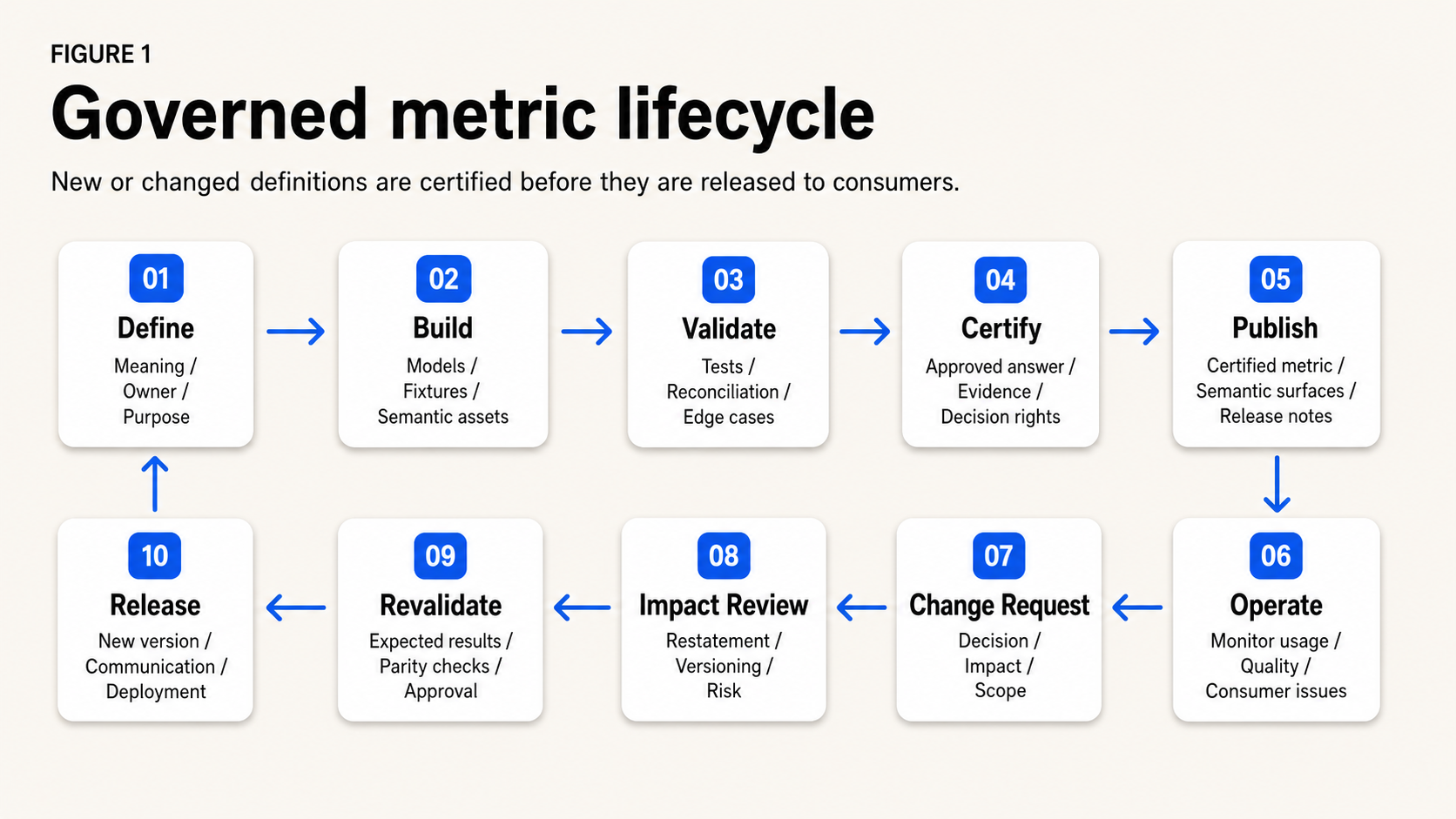
| Step | Required output |
|---|---|
| Define | Business meaning, owner, purpose, supported decisions, and approval path. |
| Specify | Metric specification covering grain, temporal rules, valid dimensions, invalid uses, quality rules, and restatement policy. |
| Build | Models, fixtures, expected outputs, semantic definitions, and deployment scripts. |
| Validate | Technical tests, expected-answer reconciliation, semantic parity checks, and quality evidence. |
| Certify | Named signoff, evidence package, accepted tolerances, exceptions, and certification status. |
| Publish and operate | Governed semantic surfaces, access controls, monitoring, lineage, and consumer communication. |
| Change and revalidate | Impact review, versioning, release note, recertification, cutover plan, and final retirement criteria. |
Contract Layers
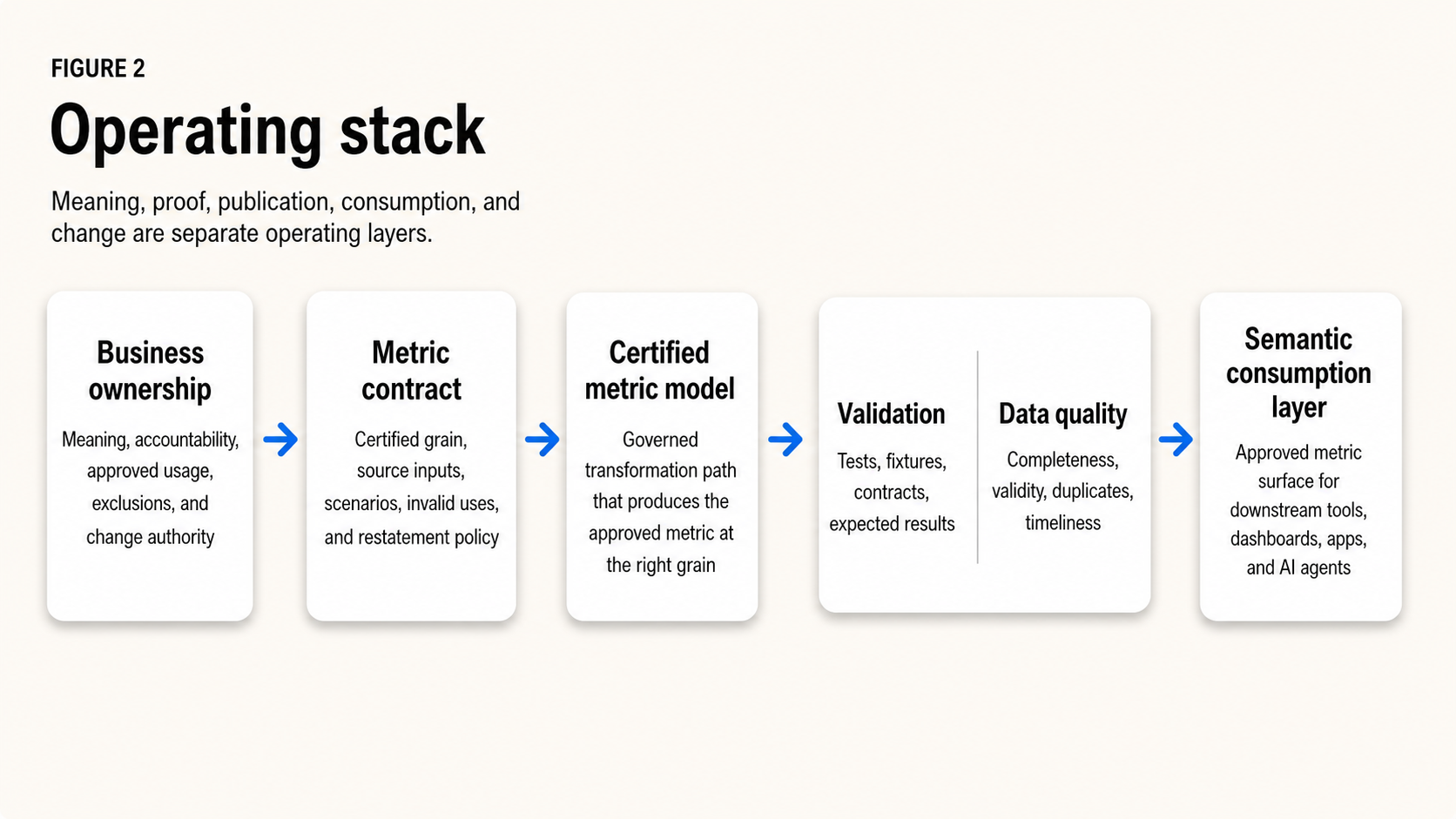
The project shows that a governed metric is protected by more than one contract. The useful pattern is a stack of contracts, each controlling a different failure mode.
| Contract layer | How the ARR project handles it |
|---|---|
| Metric contract | docs/metric_contract_arr.md owns the business definition: certified grain, owner, cadence, currency, approved dimensions, invalid uses, change process, and policy change log. |
| Transformation contract | The certified marts fct_arr_snapshot and fct_arr_movement use dbt contracts with declared columns and data types, plus not-null, relationship, and accepted-values tests. |
| Expected-answer contract | Hand-calculated fixtures act as a separate answer key for monthly Ending ARR totals, account totals, movements, and policy-change impact. |
| Semantic contract | The dbt semantic YAML and Snowflake semantic view both sit on top of the same governed marts rather than recreating ARR logic downstream. |
| Governance contract | The governance quality gate checks that required controls exist: owners, certified grain, invalid uses, semantic model, data-quality summary, expected fixtures, critical tests, and CI hooks. |
| Source contract | Not implemented as a live producer contract in the lab. The repo uses controlled Salesforce-style CSV seeds; a production version would need source ownership, freshness SLOs, compatibility rules, and ingestion-boundary checks. |
That distinction matters. A dbt model contract protects the shape of a model, not the business correctness of ARR. The expected-answer fixtures, business tests, semantic validation, and governance gate provide the additional proof that the certified output still means what the contract says it means.
Metric Specification Checklist
The metric specification is the starting asset. It should be business-readable, technical enough to implement, and specific enough to prevent downstream teams from inventing their own interpretation.
| Field | Implementation guidance |
|---|---|
| Business definition | State the approved meaning in plain language and name the decision the metric supports. |
| Certified grain | Specify the row grain and the level at which the metric is certified, such as customer-month or subscription-month. |
| Temporal rules | Define measurement date, as-of date, effective date, fiscal calendar, late-arriving data handling, point-in-time behavior, and period-ending logic. |
| Aggregation rules | State whether the metric is additive, semi-additive, or non-additive across time and dimensions; for ARR, specify where it can be summed, averaged, period-ended, or not aggregated. |
| Approved dimensions | List supported slices and dimensions; require validation before adding new slices. |
| Exclusions and edge cases | Capture statuses, products, customers, one-time charges, paused states, churn, reactivation, and other boundary cases. |
| Invalid uses | Name interpretations the metric should not support, such as summing a point-in-time ARR balance across months. |
| Expected outputs | Attach small scenarios with approved answers that business owners can review. |
| Ownership and decision rights | Name the business owner, data owner, implementer, approver, and escalation path. |
| Restatement and change policy | Define when a change is prospective, when history is restated, and who approves either path. |
ARR is only one example. ARR definitions vary by company and source system: contract ARR, billing-derived ARR, booked ARR, and recognized revenue can each answer different questions. The specification governs the chosen definition; it should not imply that one ARR definition is universal.
Ownership and Decision Rights
Ownership is not just a name beside the metric. The operating model needs decision rights so disagreements can be resolved before they become dashboard forks or unofficial spreadsheet logic.
For high-stakes metrics, the escalation path should be explicit. If Finance, RevOps, Sales Ops, and Data disagree, the metric owner decides the business meaning, Finance decides formal reporting treatment where applicable, and Data decides whether the approved rule can be implemented and validated safely.
In practice, that means the business owner approves meaning, exclusions, accepted use, and restatement decisions; Finance approves formal reporting treatment where financial interpretation matters; Data and analytics engineering own feasibility, implementation, validation, and semantic parity; and platform or security owners can block publication when access, privacy, or AI-exposure controls are incomplete.
Operational Controls
A production metric should carry enough operating metadata that consumers can tell whether the answer is approved, current, auditable, and safe to use for the decision in front of them. In the ARR lab, this is implemented as an MVP-certified Ending ARR contract with named RevOps and Data owners, approved dimensions, fixture-backed quality thresholds, semantic parity checks, and a change log for the 2025-04-01 paused-subscription exclusion.
The strongest implemented controls are the expected-answer seeds and semantic validators. They provide fixture-level control totals for monthly Ending ARR, account-level ARR, ARR movements, and the policy-change impact, then check that local and Snowflake semantic surfaces reconcile to the approved result.
Access policy is intentionally not claimed as implemented beyond environment separation and guarded Snowflake deployment. A production version would still need grants, row-level controls, masking, and AI-consumer entitlement rules.
Certification Gates
Certification is a governance decision backed by evidence. It should not be implied merely because a model built successfully or a semantic object exists.
| Gate | Minimum evidence |
|---|---|
| Specification approved | Business owner signs off on definition, grain, temporal rules, approved dimensions, invalid uses, and restatement policy. |
| Implementation complete | Models produce the metric at the certified grain with documented lineage and source mapping. |
| Validation passed | Business-rule tests, expected-answer fixtures, quality checks, and reconciliation checks pass within accepted tolerances. |
| Semantic parity proven | Published semantic surfaces return the same approved answer as the governed model for certified slices. |
| Release boundary captured | Certification status, version, effective date, known limitations, access boundary, and consumer communication are recorded. |
The reconciliation target should also be named. For ARR, that might be Finance close, CRM contracts, billing data, or another approved control total. Without an agreed control total and explicit tolerances, teams can pass tests and still disagree about whether the metric is decision-ready.
Reconciliation and Temporal Semantics
ARR disagreement often comes from time, not arithmetic. The reference project anchors certified Ending ARR to calendar month-end snapshots and uses subscription and subscription-line effective dates to decide which recurring value contributes to each period.
| Question | ARR project answer |
|---|---|
| What is the certified period? | Calendar month-end snapshots from January through June 2025 in the fixture-backed lab. |
| What is the certified grain? | snapshot_date x account_id x subscription_id x product_family. |
| How is annualized value calculated? | line_arr = net_amount_per_period x 12 / billing_interval_months for eligible active lines. |
| How are movements reconciled? | fct_arr_movement compares account-level Ending ARR between consecutive month-end snapshots and classifies new, expansion, contraction, churn, and reactivation. |
| How is the policy change proven? | expected_ending_arr_after_policy_change stores before-policy, after-policy, and impact amounts; assert_policy_change_impact_expected validates the 1200.00 exclusion from April 2025 onward. |
| What is not proven? | Recognized ARR or Finance-close reconciliation is explicitly deferred. The repo proves fixture-level metric reconciliation, not full finance-system tie-out. |
That last boundary is important. The lab can prove that dbt marts and semantic outputs match hand-calculated expected answers. A production revenue metric would still need a named reconciliation target, such as Finance close, billing, CRM contracts, or another approved control total.
Validation Package
The validation package is the proof that the metric behaves as intended. It should include both engineering checks and business-readable expected-answer evidence.
| Validation component | What to verify |
|---|---|
| Source completeness | Required inputs exist for the reporting window and expected entities are present. |
| Source validity | Statuses, dates, billing intervals, product flags, currencies, and identifiers use approved values. |
| Grain and relationships | Entities join without unintended fanout, duplication, orphan records, or grain drift. |
| Business-rule tests | Eligibility, exclusions, renewals, churn, pauses, reactivation, discounts, and product rules behave as specified. |
| Temporal tests | Effective dates, as-of dates, fiscal calendars, late-arriving data, and snapshot behavior are correct. |
| Expected-answer fixtures | Small controlled scenarios reconcile to business-approved outputs. |
| Aggregation tests | Additive, semi-additive, and non-additive behavior is enforced across time and dimensions. |
| Semantic parity | dbt semantic metrics, Snowflake Semantic Views, BI models, or APIs return the same certified result where supported. |
| Deployment validation | Production objects exist, expose the approved metric, and reconcile after release. |
The strongest validation is often a small expected-answer fixture. It gives business owners something concrete to approve without asking them to inspect every SQL expression.
In the ARR project, the fixtures cover monthly Ending ARR totals, account-level totals, ARR movement classifications, and the paused-subscription policy change. Unit tests isolate annualization, eligibility, subscription and line effective dates, and movement classification; singular tests compare the produced facts to the expected answer seeds.
dbt and Semantic Layer Operating Mechanics
The ARR repo makes the operating model concrete in dbt rather than leaving it as documentation. The certified marts use enforced contracts, explicit columns, data types, not-null checks, relationship checks, accepted movement values, and singular tests against independent expected-answer fixtures.
| Mechanic | Implemented pattern |
|---|---|
| Model contracts | fct_arr_snapshot and fct_arr_movement declare contract.enforced: true with typed certified outputs. |
| Grain protection | assert_snapshot_grain checks one row per snapshot_date, account_id, subscription_id, and product_family. |
| Business-rule tests | Tests cover annualization, pricing math, ineligible-line exclusion, active subscription windows, active line windows, non-negative Ending ARR, expected totals, expected account totals, and movement classification. |
| Unit tests | dbt unit tests isolate eligibility, EUR-only scope, recurring-product annualization, subscription and line boundaries, and new/expansion/contraction/churn/reactivation movement logic. |
| Semantic validation | scripts/validate_semantic_contract.py checks semantic entities and dimensions, non-additive Ending ARR behavior, expected ARR totals, dimension joins, and rejects invalid summing across snapshots. |
| CI gates | GitHub Actions runs dbt parse for DuckDB, Snowflake development, and production targets; focused unit tests; modified-state build; full local build; semantic validation; and governance validation. |
| Snowflake validation | scripts/deploy_snowflake_semantic_view.py validates that the Snowflake semantic view exists, exposes certified Ending ARR, and returns totals matching expected fixtures. |
This is the difference between saying a metric is governed and proving it in the delivery path. A pull request can change SQL, YAML, docs, fixtures, or tests, but the build has to preserve the certified answer and the governed semantic contract before the change is releasable.
Data Quality and Observability
Data quality is not only a build gate. Once a metric is in use, the team needs operating visibility into whether the inputs and outputs remain healthy enough for decision-making.
In the ARR lab, DQ models expose completeness, validity, duplicate-risk, freshness and coverage, referential-integrity, and summary views for the staging inputs. Some failures should block a build; others should become monitored exceptions with thresholds, incident owners, and communication rules.
For production use, the missing layer is ongoing observability: freshness SLOs, movement review, lineage to dashboards and AI consumers, and an incident process that names who investigates, who decides business impact, and who communicates when the metric is unhealthy.
Semantic Publication
A governed metric only creates value if people and systems can consume it safely. The semantic layer should provide the controlled interface to the approved metric: supported dimensions, joins, labels, aggregation behavior, synonyms, and verified question patterns where the platform supports them. It should not recreate the metric logic in each downstream tool.
| Path | Role |
|---|---|
| dbt Semantic Layer | Defines the metric in dbt-native YAML through semantic models, entities, dimensions, measures, and metrics for MetricFlow-compatible consumers. |
| Snowflake Semantic View | Creates a Snowflake-native semantic object with business-friendly dimensions, facts, metrics, synonyms, verified queries, and instructions where supported. |
| BI semantic model | Provides a governed reporting surface for dashboards and self-service exploration. |
| Metric API or application surface | Exposes the approved metric to applications, workflows, or operational tools. |
The governed metric contract and certified marts remain the source of truth. Semantic objects are deployed representations that must reconcile to the same approved answer.
In the ARR project, the dbt semantic model and the Snowflake semantic view both depend on fct_arr_snapshot, fct_arr_movement, and dim_account. That is the system-of-record pattern: multiple semantic surfaces are allowed, but none of them owns or rewrites the ARR calculation.
The Snowflake path goes further by exposing certified_ending_arr, net_arr_movement, synonyms, AI instructions, and verified queries. The deployment validator checks that the semantic view exists, exposes the MVP-certified Ending ARR output, and returns fixture-matching ARR totals.
AI Consumption Controls
AI-assisted consumption should be treated as a governed consumer, not as an exception to the operating model. The ARR repo implements the metadata side of that pattern in the Snowflake semantic view: synonyms, AI SQL-generation instructions, question categorization guidance, and verified queries for common ARR questions.
| Control | Practical requirement |
|---|---|
| Approved surfaces | Implemented as guidance: AI should use the certified semantic view and not raw source tables. |
| Golden questions | Implemented through Snowflake semantic-view verified queries for ARR over time, ARR by segment, and ARR movements by type. |
| Unsupported questions | Implemented as semantic-view instructions: reject attempts to redefine ARR, include paused subscriptions after the policy date, or treat ARR as revenue, cash, pipeline, or recognized revenue. |
| Access boundaries | Not implemented in the lab. A production version would inherit user entitlements and apply row, column, role, and privacy controls. |
| Query and result audit | Not implemented in the lab. A production version would log prompts, generated queries, semantic version, user identity, and downstream usage where policy allows. |
| Evaluation set | Partially implemented through verified queries and fixture validation. A production assistant would need a broader evaluation suite covering expected answers, approved dimensions, and refusal behavior. |
The repo supports the principle that AI should consume certified metric outputs. It does not claim a fully deployed assistant with entitlement inheritance, audit logging, or broad answer evaluation.
Deployment Validation
Deployment validation proves that the consumption surface returns the certified answer. In the ARR repo, the Snowflake path is optional and deliberately guarded: production deployment is manual, environment approval can be required, and the semantic view deployment is enabled only when the relevant repository variable is set.
| Deployment check | Evidence |
|---|---|
| Target parsing | CI parses DuckDB, isolated Snowflake development, and production targets before merge. |
| Local build | CI runs the full DuckDB dbt build and data-test suite against controlled fixtures. |
| Semantic contract | make semantic-validate checks semantic metadata, expected ARR totals, account dimension joins, and non-additive Ending ARR behavior. |
| Governance gate | make governance-check verifies required metric-product controls before release. |
| Snowflake object check | The deployment validator checks that ARR_LAB.SEMANTIC.REVENUE_METRICS exists and exposes CERTIFIED_ENDING_ARR. |
| Semantic result parity | The Snowflake validator queries semantic_view() and compares certified Ending ARR to expected post-policy-change fixtures within 0.01. |
| Production extension | Rollback procedures, row-level access policy validation, dashboard smoke tests, and hosted dbt Semantic Layer query proof are not fully implemented in the lab. |
The final deployment question is simple: does the deployed semantic surface still return the certified result for the approved metric and time behavior? In this repo, that answer is checked with fixture-backed semantic-view validation, not assumed from a successful deployment.
Change and Deprecation Controls
Metric changes should move as an auditable release, not as a quiet SQL edit. In the ARR lab, the change is deliberately small: paused subscriptions are excluded from certified Ending ARR from 2025-04-01 onward. The value is not the rule itself; the value is that the rule can be operated as a complete change packet.
| Control | ARR example |
|---|---|
| Business decision | Paused subscriptions no longer count toward certified Ending ARR. |
| Effective date | Apply the policy from 2025-04-01 onward. |
| Restatement decision | Prospective change; prior certified periods remain unchanged unless Finance approves restatement. |
| Affected assets | Eligibility logic, monthly ARR facts, expected-answer fixtures, semantic definitions, dashboards, and AI-facing metadata where supported. |
| Validation evidence | Fixture data, expected monthly totals, business-rule tests, semantic parity checks, and deployment validation. |
| Release evidence | Versioned release note, consumer communication, access review, rollback path, and certification signoff. |
Do not deprecate a metric before its replacement is defined, validated, certified, released, communicated, and recoverable.
The ARR repo demonstrates this with a scoped definition change rather than a theoretical workflow. The change document records the business reason, previous definition, new definition, effective date, prospective restatement decision, expected impact, affected assets, required RevOps, Finance, and Data approvals, release note, and validation command.
Repeat the Pattern
A team does not need an enterprise-wide catalog to start. It needs one metric important enough to matter and complex enough to expose real operating questions. The ARR repo is best read as a thin-slice pilot, not as a full enterprise deployment.
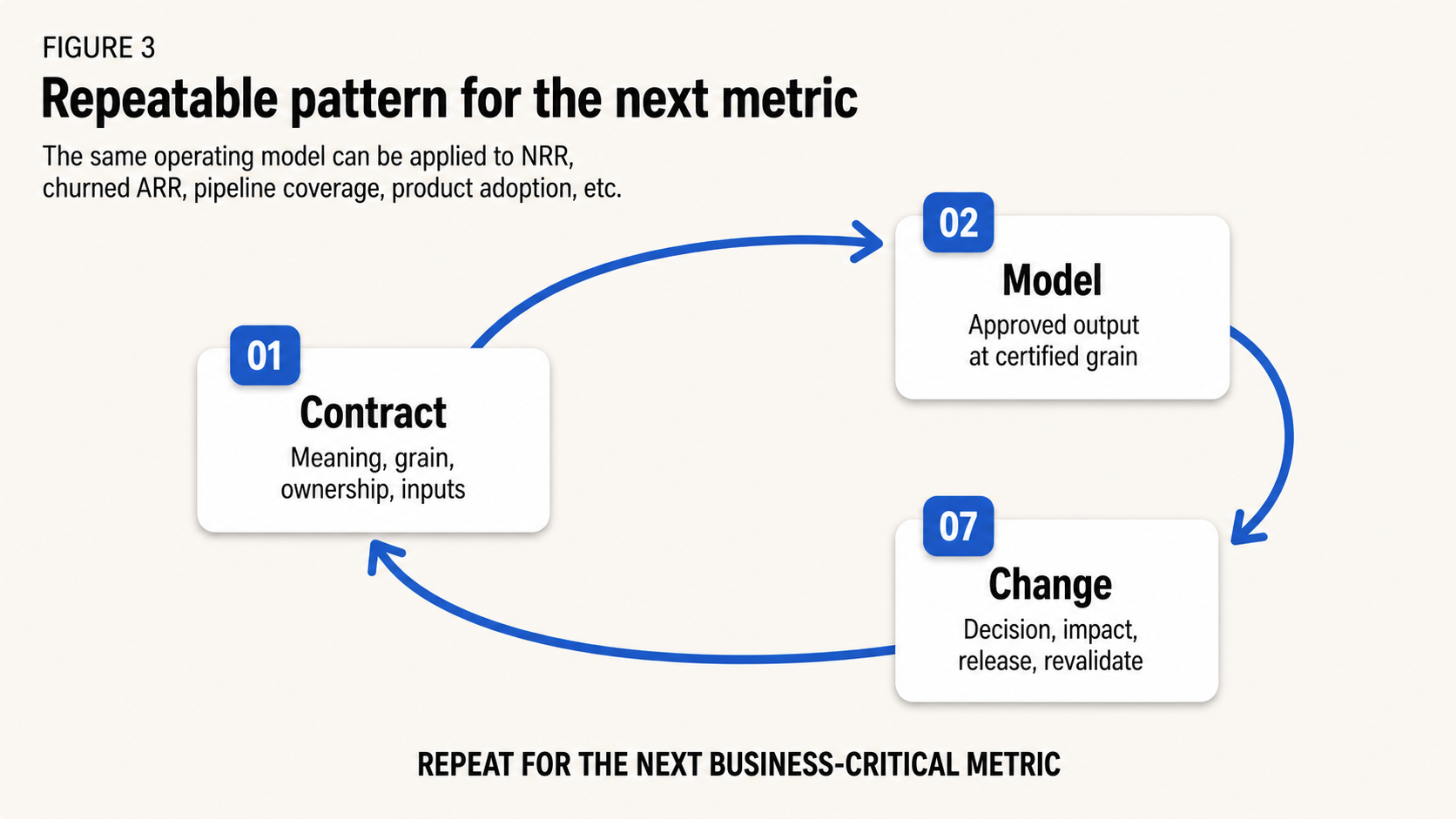
One well-governed metric is enough to prove the model. The pattern can then be repeated for Net Revenue Retention, Gross Revenue Retention, active customers, churned ARR, customer health, pipeline coverage, product adoption, support SLA performance, and sales productivity.
The metric family can change, but the operating questions remain stable: what does the metric mean, who owns it, what is its grain, how does time work, what proves the answer, where is it published, who consumes it, and what happens when it changes?
The payoff is not governance theater. It is fewer recurring metric disputes, less rework before executive reviews, safer definition changes, and a clearer path for exposing trusted metrics to dashboards, workflows, and AI consumers.
The goal is not to govern every metric at once. It is to prove, with one business-critical metric, that the organization knows how a trusted metric is specified, built, validated, certified, published, operated, changed, and retired safely.
The point of the blueprint is not to make governance heavier. It is to make trust operational. A metric becomes decision-ready when its meaning, implementation, validation evidence, semantic surfaces, access boundaries, and change path can all be inspected and repeated for the next critical metric.